AT A GLANCE
- FDA-cleared goal
- Lift lax neck and submental tissue
- Planning aid
- Real-time visualization of tissue and transducer coupling
- Does not replace
- Fat, muscle-band, structural or surgical assessment
- Evidence limit
- Mostly small studies with variable protocols and follow-up
- Reviewed
- 1 November 2026
The short answer: yes for selected lax tissue, not every neck concern
The Ulthera System is FDA-cleared to lift lax tissue on the neck and beneath the chin. That makes a gradual tightening response possible in selected people; it does not promise a sharply defined jawline, a fixed degree of lift or the same response for every anatomy.
A neck that looks loose, full or less defined may reflect skin laxity, submental fat, platysmal muscle bands, gland position, chin structure, weight change or more advanced tissue descent. Ultherapy does not diagnose those causes, selectively remove a fat pocket or reproduce the tissue removal and repositioning possible with surgery.
AP865's current official program lists ULTHERAPY PRIME. That confirms the consultation scope, not individual suitability. The first decision is whether lax tissue is actually the main finding and whether a conservative, visualized treatment map can respect the person's anatomy, prior procedures and recovery responsibilities.
What focused ultrasound and real-time visualization contribute
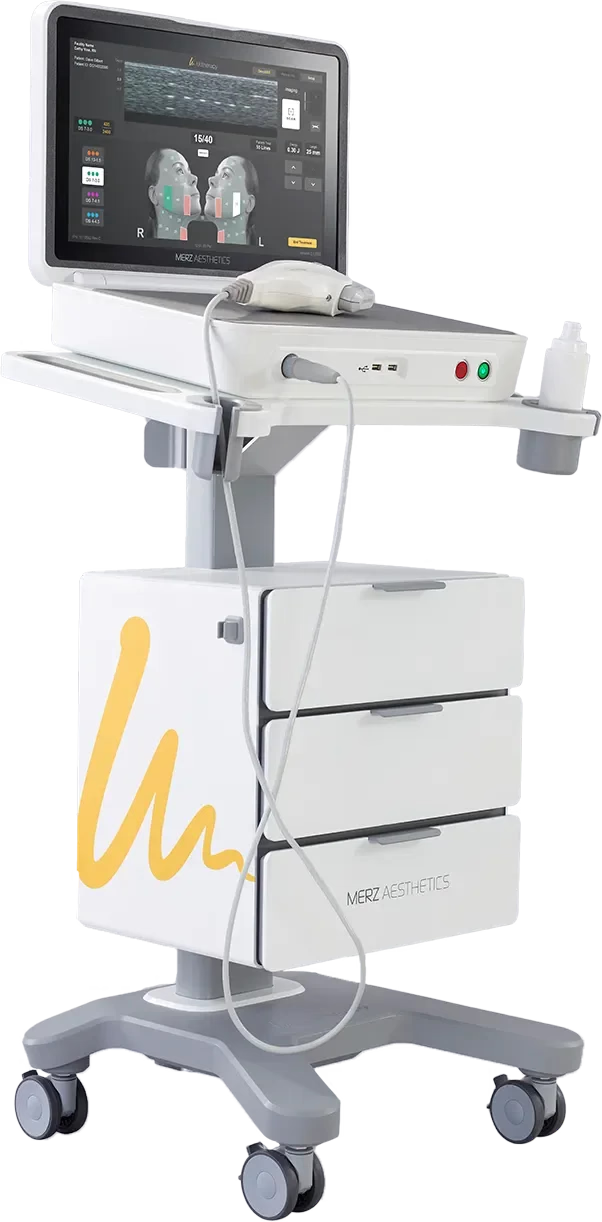
Ultherapy Prime delivers focused ultrasound below the skin surface to create controlled thermal coagulation points. The tissue response develops over time. The current FDA and manufacturer records describe noninvasive aesthetic use, while the DeepSEE function visualizes dermal and subdermal layers to support coupling and selection of treatment depth.
Visualization is useful because the neck is curved and anatomically varied. A study of face and neck treatment found that real-time visualization improved the likelihood of proper transducer contact, with the largest observed difference at the upper neck. That finding supports careful visualization; it does not automate diagnosis, select the correct depth or make a larger treatment map safer.
The operator still decides which tissue layer is appropriate, where each line begins and stops, and which areas should be avoided. Device name, line count and energy level cannot substitute for an anatomy-led map. A smaller plan may be more coherent when tissue is thin, asymmetrical or altered by earlier treatment.
What the clinical evidence supports—and where it stops
The FDA record that expanded the Ulthera indication to lax submental and neck tissue describes an open-label study of 70 participants. The summary reported objective and masked-evaluator improvement in a proportion of participants, with no treatment-related serious adverse events in that study. An open-label study can support an indication, but it does not predict the visible change for one person.
A 2016 study enrolled adults with lower-face and neck laxity and evaluated customized treatment at one or two focal depths. Investigators and participants reported changes through 180 days, but allocation was not randomized and the authors did not establish one universal depth pattern. A separate randomized trial of 20 people found improvement with both microfocused ultrasound and monopolar radiofrequency through 180 days, without a significant difference between the two groups.
These studies make a gradual response plausible while also showing the limits of comparison. Samples were small, protocols differed and outcomes depended on selected participants and assessment methods. Standardized photographs, the same head position and a pre-agreed review point are more reliable than an immediate selfie or a promised percentage.
Who may discuss it—and when another assessment should lead
Someone with mild-to-moderate lax tissue on the neck or beneath the chin may discuss Ultherapy after an in-person examination. The physician should observe the lower face and neck at rest and in movement, palpate the tissue, review previous procedures and ask which change would be meaningful. A photograph or age alone cannot establish suitability.
The current instructions list open wounds or lesions, severe or cystic acne in the treatment area and active or metallic implants in the treatment area among contraindications. They also identify medical histories and conditions that require caution. Disclose implants, scars, threads, fillers, surgery, altered sensation and every previous energy treatment by exact name, date and location.
Another evaluation should come first when the dominant finding is a defined fat pocket, strong vertical muscle bands, gland prominence, marked tissue descent, unexplained swelling or a structural chin issue. The appropriate next step may be observation, another treatment category, a staged plan or referral. A private consultation should leave room for no procedure.
- Is the main concern lax tissue, fat, muscle bands or structural anatomy?
- Which tissue layer is visible and appropriate for each proposed line?
- Which neck areas will be treated, reduced or deliberately avoided?
- What previous procedures, implants or altered sensation affect the map?
- Would staging make recovery and response easier to interpret?
Recovery is often manageable, but the risk list is real
The current instructions describe redness, swelling, welting, pain, tenderness and bruising among reported clinical-trial effects. Temporary numbness, tingling or localized muscle weakness can occur. Burns and scarring are possible when technique is incorrect, and post-market reports include nerve effects, fat or volume loss, asymmetry and vision changes.
Seek prompt in-person assessment for suspected burn, blister, increasing pain, severe or progressive swelling, new weakness, persistent numbness, vision change or another symptom that is severe or worsening. Photographs and messaging can support communication but cannot replace examination of an unexpected thermal, neurologic or eye-area symptom.
For an overseas visitor, recovery planning should preserve time for a local review and a written route to follow-up after departure. Combining injections or another energy treatment on the same day can complicate both recovery and attribution. Sequence and spacing should follow the examined skin, anatomy and travel schedule rather than a preset bundle.
Ultherapy, Thermage and surgery answer different questions
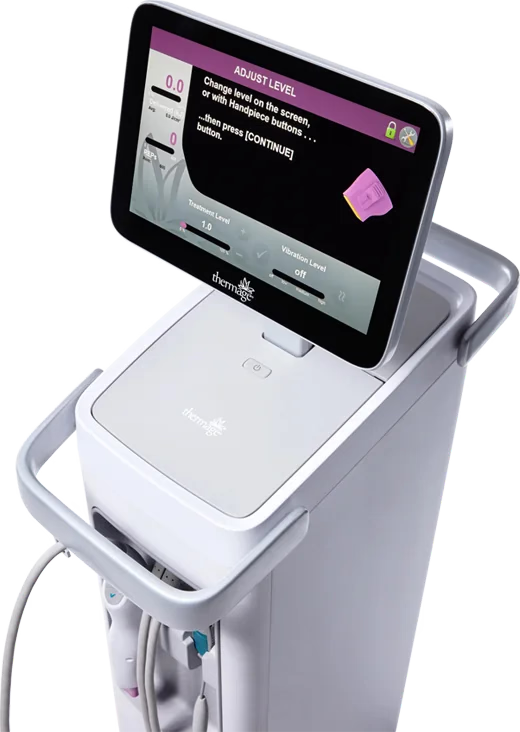
Ultherapy uses focused ultrasound with visualization to place energy at selected depths. Thermage uses monopolar radiofrequency to heat a broader tissue volume through a skin-contact tip. A small randomized neck study found improvement with both categories and no significant difference between them, but it was not large enough to declare one universal winner.
The meaningful comparison is the tissue finding. Focused ultrasound may be discussed when a deeper, visualized target fits the anatomy; monopolar radiofrequency may be discussed when a broader heating approach fits the examined skin. Neither category can be selected responsibly from age, a device name or a headline line count alone.
Surgery can remove or reposition tissue in ways that noninvasive devices cannot. When laxity or muscle-band change is advanced, describing a device as equivalent to a neck lift would be misleading. The honest consultation explains the likely scale of noninvasive change and when referral offers the clearer answer.
How AP865 turns a device question into a continuity plan
A private AP865 consultation should begin with the person's goal, examination, previous records and travel responsibilities—not a preset number of lines. The physician can explain which finding the proposed map addresses, what will remain unchanged and why a conservative or staged plan may be more coherent.
If treatment proceeds, the record should identify the device model, transducer, visualized depth, treatment map, date, expected response, aftercare and contact route. Standardized photographs should use the same lighting, head position and expression. Privacy should be agreed before any neck images are exchanged for follow-up.
Change is generally reviewed over weeks to months, so continuity matters more than an immediate visual claim. Agree on the meaningful review point, warning signs that require earlier assessment and which records should travel with the visitor. That makes treatment part of longitudinal skin and aging care rather than an isolated machine appointment.
COMMON QUESTIONS
Before you book
Is Ultherapy FDA-cleared for the neck?
Yes. The Ulthera System is FDA-cleared to lift lax neck and submental tissue. Clearance does not guarantee a particular amount of lift or establish suitability for every neck concern.
Can Ultherapy remove a double chin?
Ultherapy does not diagnose or selectively remove every cause of a double-chin appearance. Skin laxity, fat, muscle, gland position and chin structure require an in-person assessment.
When might a neck change become visible?
Published neck studies assessed change over weeks to months as the tissue response developed. Timing and visibility vary, so the physician should set a realistic review point rather than promise a fixed schedule.
Is Ultherapy the same as Thermage for the neck?
No. Ultherapy uses focused ultrasound with visualization, while Thermage uses monopolar radiofrequency. The examined tissue target, anatomy, evidence and safety boundaries should determine which category is discussed.
Is Ultherapy equivalent to a surgical neck lift?
No. Surgery can remove or reposition tissue in ways that a noninvasive ultrasound treatment cannot. A consultation should explain the expected scale and limits of change honestly.
SOURCES & FURTHER READING
Check the original information
- AP865 — official current program overview
- US FDA — Ulthera System with UC-1 PRIME 510(k) summary K233996
- Ultherapy Prime — current instructions for use and safety information
- US FDA — expanded submental and neck indication record K121700
- PubMed — customized MFU-V treatment of lower-face and neck laxity
- PubMed — randomized MFU-V versus monopolar RF upper-face and neck trial
- PubMed — randomized MFU-V versus monopolar RF neck trial
- PubMed — accuracy of focused ultrasound with real-time visualization
Published November 1, 2026 · Last reviewed for factual accuracy November 1, 2026. Product availability, regulation and treatment protocols can change.