AT A GLANCE
- Energy
- 6.78 MHz monopolar radiofrequency
- Possible target
- Selected wrinkles and skin laxity
- Does not replace
- Fat, muscle-band or surgical assessment
- Evidence limit
- Small studies include earlier Thermage generations
- Reviewed
- 30 October 2026
The short answer: it may help selected neck laxity, not every neck concern
Thermage FLX can be discussed when the main concern is neck wrinkles or mild-to-moderate skin laxity. The current manufacturer information describes noninvasive treatment of wrinkles and rhytids, and published studies of monopolar radiofrequency have reported gradual changes in selected neck-laxity groups. Neither source promises a neck lift for every person.
A neck that looks heavy, loose or less defined can reflect several different structures. Skin laxity is not the same as submental fat, platysmal muscle bands, salivary-gland position, a small chin, weight change or more advanced tissue descent. Thermage does not diagnose those causes, remove a specific fat pocket or reproduce the repositioning possible with surgery.
AP865's current official program lists Thermage FLX. That confirms the consultation scope, not personal suitability. The useful first decision is whether radiofrequency matches the tissue creating the visible concern and whether a conservative treatment map can respect the person's anatomy, previous procedures and recovery responsibilities.
What the Thermage FLX platform changes—and what it does not
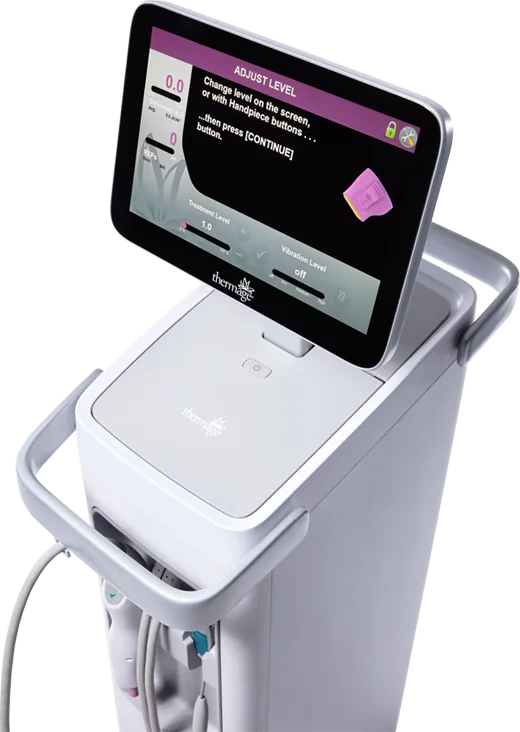
Thermage FLX delivers 6.78 MHz monopolar radiofrequency through a disposable treatment tip while conductive cooling helps protect the surface. The FDA record describes selective tissue coagulation with skin-contact monitoring, and the manufacturer describes AccuREP calibration, cooling and vibration features. Those controls support energy delivery; they do not select the correct patient or create one standard neck pattern.
The manufacturer lists Total Tips for lines and wrinkles and states that results around the jawline and under the chin may vary. Tip choice, skin contact, coupling, passes, treatment boundaries, energy and patient feedback belong to one physician-led plan. A shot count by itself does not reveal tissue depth, mapping quality or likely outcome.
Because the neck is not a flat or uniform surface, the map should be explained before treatment. Prominent vessels, the thyroid region, scars, previous surgery, implants and altered sensation may change the examination or the decision to proceed. A larger treatment area is not automatically a more complete plan.
The evidence supports possibility—not a predictable degree of lift
A 2004 prospective study treated 20 people with mild-to-moderate neck laxity using the earlier ThermaCool system. Masked assessors reviewed standardized photographs through six months, and the authors reported improvement in most participants with transient redness, swelling and rare altered sensation. The study was small, used an earlier device generation and did not establish what one current FLX protocol will do for an individual neck.
A 2017 randomized evaluator-blinded trial included 20 people with moderate neck laxity and compared subsurface monopolar radiofrequency with microfocused ultrasound. Both groups improved on investigator and participant measures by 90 days, with changes persisting at 180 days. The sample was small, and the abstract does not turn either technology into a universal first choice.
These studies make a gradual neck response plausible. They do not show that every visible neck concern is skin laxity, determine one ideal number of treatments or support a guaranteed contour. Standardized photographs, the same head position and a pre-agreed review point are more reliable than comparing unmatched selfies soon after treatment.
Who may discuss it—and when another assessment should come first
Someone with mild-to-moderate neck skin laxity or wrinkles may discuss monopolar radiofrequency after an in-person examination. The physician should assess the face, jawline, chin and neck together, observe movement, palpate the tissue and ask what change the person considers meaningful. A photograph or age alone cannot establish suitability.
Pause when there is active inflammation, infection, an open lesion, unexplained swelling, altered sensation or an unresolved reaction in the proposed area. Disclose every previous neck or facial procedure, implant, thread, filler and energy treatment by name, date and location. The manufacturer lists an implantable pacemaker, automatic implanted defibrillator or another implantable electrical device as a contraindication and identifies additional populations and situations that have not been studied.
Another assessment should lead when the main finding is a defined fat pocket, strong vertical muscle bands, a structural chin issue, gland prominence or marked tissue descent. The appropriate next step may be observation, a different treatment category, a staged plan or referral. A private consultation should leave room for no procedure rather than forcing the concern into a Thermage label.
- Is the main concern skin laxity, wrinkles, fat, muscle bands or structure?
- Which areas will be treated, reduced or deliberately avoided?
- Which tip and mapping logic fit the examined anatomy?
- What prior neck, jawline or injectable procedures affect the plan?
- Would a staged approach make safety and response easier to interpret?
Recovery is often limited, but the risk list is not empty
Temporary warmth, redness, blanching, swelling, tenderness, bruising or altered sensation can occur. The current manufacturer safety information also lists urticaria, blisters, burns, scabbing, scarring, surface irregularities, lumps or nodules and pigment change among reported reactions. A short appointment or return to ordinary activity should not be described as zero recovery or zero risk.
Seek prompt in-person assessment for a blister, suspected burn, increasing pain, marked swelling, spreading redness, new weakness, persistent numbness or another symptom that is severe or worsening. Remote photographs can support communication but cannot replace examination of an unexpected thermal injury or neurologic symptom.
For an overseas visitor, the plan should preserve time for a local review and a clear route to follow-up after departure. Adding injections, ultrasound or another energy treatment on the same day can make recovery and attribution harder to interpret. Sequence and spacing should follow the examined tissue and medical record, not a desire to fit every option into one visit.
Thermage, focused ultrasound and surgery answer different questions
Thermage uses noninvasive monopolar radiofrequency and does not provide real-time ultrasound imaging. Microfocused ultrasound with visualization places focused energy at selected visualized tissue depths. A small randomized neck study found improvement with both categories and no statistically significant difference in its limited sample; it does not establish that one is universally better.
Surgery can remove or reposition tissue in ways that a noninvasive energy device cannot. That does not make surgery the required answer for every concern, but it defines an honest boundary. When the desired change requires structural repositioning, describing Thermage as an equivalent substitute would set the wrong expectation.
A physician-led comparison should therefore begin with the target and acceptable recovery, then discuss the least expansive approach that plausibly addresses it. Combining technologies is not automatically more effective, and declining or staging treatment can be the more coherent decision.
How AP865 can make a neck plan private, specific and continuous
A private AP865 consultation should document the person's concern in their own words, examine the full lower face and neck, and separate the findings before discussing a device. The physician can explain which visible features may change modestly, which are outside Thermage's role and why treating less—or not treating—may better preserve the person's proportions.
If treatment proceeds, the record should include the exact device, tip, treated and avoided zones, date, expected response, aftercare and urgent-contact route. Standardized photographs should use consistent head position, expression and lighting, with explicit agreement about storage and follow-up privacy.
Continuity matters because a radiofrequency response is gradual and individual. Agree on a meaningful review point, what should trigger earlier assessment and how the record will travel with an international visitor. That turns a neck procedure into one considered step within long-term skin and aging care rather than an isolated machine appointment.
COMMON QUESTIONS
Before you book
Can Thermage FLX tighten loose neck skin?
It may support a modest, gradual change in selected mild-to-moderate neck laxity, but response varies and the physician must first confirm that skin laxity is the main concern.
Does Thermage remove a double chin?
Thermage is not a diagnostic test or a guaranteed fat-removal treatment. A double-chin appearance may reflect skin, fat, muscle, chin structure or several factors, which require an in-person assessment.
Is Thermage the same as a surgical neck lift?
No. Thermage is a noninvasive radiofrequency procedure. Surgery can remove or reposition tissue in ways that Thermage cannot, so the two should not be presented as equivalent.
When might a neck change be visible?
Published neck studies assessed change over weeks to months rather than immediately. Timing and visibility vary, so the physician should set a realistic review point instead of promising a fixed schedule.
Who should not assume Thermage is suitable?
Anyone with an implantable pacemaker, automatic implanted defibrillator or another implantable electrical device should not receive Thermage. Other medical histories, implants, active skin problems and previous procedures also require individual review.
SOURCES & FURTHER READING
Check the original information
- AP865 — official current program overview
- Thermage — current FLX system information and safety language
- US FDA — Thermage FLX 510(k) record K170758
- US FDA — Thermage FLX 510(k) summary K170758
- PubMed — prospective ThermaCool study of cheek and neck laxity
- PubMed — randomized monopolar RF versus MFU-V neck trial
- PubMed — randomized ThermaCool trial for middle and lower face laxity
Published October 30, 2026 · Last reviewed for factual accuracy October 30, 2026. Product availability, regulation and treatment protocols can change.