
AT A GLANCE
- Short answer
- Annual maintenance is common, not mandatory
- Result timeline
- Visible change may continue over 2–6 months
- Official duration language
- Results may last 1–2 years and vary by person
- Repeat decision
- Reassess response, tissue, records, goals and safety
- Reviewed
- 6 November 2026
The short answer: one year is common, but it is not a rule
Thermage FLX can be discussed again after a previous treatment, but there is no universal calendar that says every person should repeat it at 12 months. The current manufacturer describes annual treatment as a maintenance choice made by many patients. That is different from a requirement, a guarantee or proof that an earlier or later date is wrong.
The result is also not finished on the day of treatment. The manufacturer says visible improvement may continue over two to six months as collagen remodeling develops, and that results may last one to two years depending on skin condition and aging. Scheduling another session before the previous response is understood can make it harder to judge what changed and whether treatment still matches the concern.
AP865's current official program lists Thermage FLX. That confirms the consultation scope, not a preset annual appointment. The repeat decision should follow an in-person examination, the previous device and area record, recovery history, current photographs and a fresh discussion of what the person now wants to change.
What the annual interval evidence actually shows
A 2020 questionnaire study analyzed responses from 52 Korean dermatologists using Thermage FLX. One year was the most commonly reported interval, chosen by 51.9% of respondents. This is useful evidence about practice patterns in Korea; it is not a randomized comparison of different repeat intervals and it does not establish that yearly treatment produces the best outcome for every patient.
A 2026 narrative review discusses repeated monopolar radiofrequency as a possible preventive or maintenance strategy. Its conclusion is deliberately cautious: the evidence is preliminary, and prospective long-term studies are still needed to determine the benefits of consistent annual treatment. Several authors also disclosed relationships with the manufacturer, which should be considered when interpreting the review.
The honest conclusion is therefore narrower than a yearly subscription message. Annual treatment is a recognizable manufacturer and clinical-practice pattern. The evidence does not define a compulsory interval, prove cumulative benefit for every face or replace physician reassessment.
Why the previous result should be reviewed before repeating
A repeat plan starts with the previous treatment record: exact device model, date, treatment area, tip, pulse count, settings, comfort, immediate reaction and later symptoms. The physician should also ask what improvement the patient noticed, when it appeared, whether it remained meaningful and which features did not change.
Standardized photographs are more useful than memory alone. They should use consistent position, expression, distance and lighting, with clear consent for storage and review. Even then, photographs do not diagnose the tissue responsible for a concern. Weight change, volume change, muscle activity, skin laxity and structural aging can alter the picture between appointments.
Repeating the same device does not mean copying the same treatment map. The face, neck or body area must be examined again. A responsible plan may change the area, defer treatment, choose a different category or recommend no procedure when the current concern falls outside what noninvasive monopolar radiofrequency can reasonably change.
When a maintenance discussion may be reasonable—and when to pause
A maintenance discussion may be reasonable when the original treatment and recovery are well documented, the person found the gradual change worthwhile, the same broad concern remains relevant and an examination confirms that Thermage FLX still fits the tissue and treatment area. The goal should be stated in realistic terms rather than assuming that repeating treatment will reproduce or compound the first result.
Pause when the previous device, area or date is uncertain; the response has not had time to evolve; photographs and symptoms are inconsistent; or an earlier reaction remains unexplained. New numbness, persistent tingling, surface irregularity, a lump, pigment change, a suspected burn or worsening pain needs assessment rather than another energy treatment.
Thermage should not be performed in someone with a cardiac pacemaker, cardioverter, defibrillator or another electrical implant, according to the current manufacturer safety information. Other health histories, implants, prior procedures and active skin concerns require individual review against current instructions. An online article cannot clear a person for treatment.
How Thermage FLX works—and why timing is not only about fading
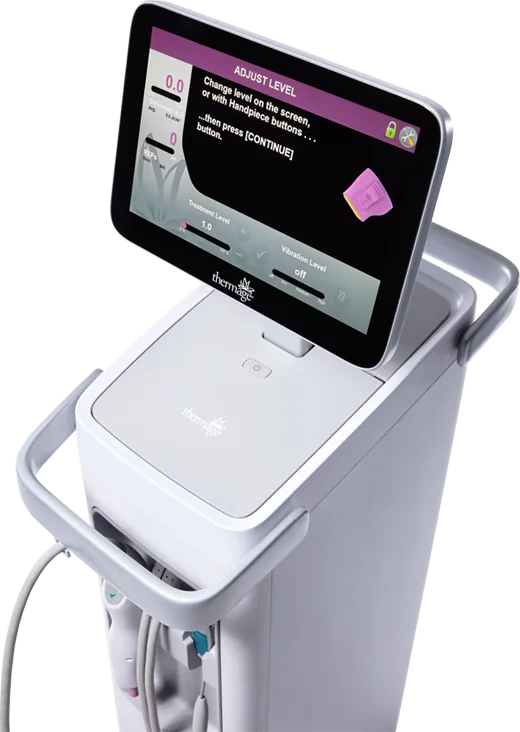
Thermage FLX delivers 6.78 MHz monopolar radiofrequency through a skin-contact treatment tip while integrated cooling helps protect the surface. The FDA record covers noninvasive treatment of wrinkles and rhytids, including periorbital areas, and the manufacturer describes continuous adjustment of energy delivery during treatment.
The treatment creates a controlled thermal effect intended to support collagen remodeling. Some visible change may appear early, while further change can develop over months. That gradual biology is one reason a repeat interval should not be set only by an event date or by the moment someone first thinks a result is fading.
An older clinical review noted that individual results from monopolar radiofrequency are unpredictable and that realistic expectations are essential. Newer hardware does not remove that principle. Device authenticity, the correct single-use tip, conservative mapping, patient feedback and the operator's judgment all matter, but none makes a personal result certain.
Recovery and risks still matter on a repeat visit
Many people return to ordinary activities shortly after Thermage FLX, and the current manufacturer describes temporary redness or swelling as common possibilities. A familiar recovery from a previous session does not guarantee the next session will feel or heal identically. Area, settings, tissue condition and individual sensitivity can differ.
Important uncommon reactions in the current safety information include burns, blisters, scabbing, scarring, surface irregularities, altered sensation, lumps or nodules and pigment change. Mild-to-moderate treatment pain is the most commonly reported effect during treatment. These risks should be discussed again rather than treated as already consented because the patient has had Thermage before.
After treatment, seek prompt review for a suspected burn or blister, severe or increasing pain, progressive swelling, persistent altered sensation, weakness or another unexpected symptom. International visitors need a local review window, written treatment record and a clear contact route after departure; remote follow-up cannot replace an examination when a significant problem develops.
Do not turn maintenance into automatic treatment stacking
A repeat Thermage discussion may occur alongside questions about focused ultrasound, fillers, threads, injectables or another radiofrequency platform. That does not make same-day or same-trip treatment automatically appropriate. Each procedure has a different tissue target, risk profile, recovery pattern and evidence base.
The physician should identify the purpose of each proposed step, review previous product and device records, choose an order and explain the interval. Staging can protect interpretability: if response or an unexpected symptom occurs, it is easier to understand which intervention may be responsible. It can also prevent a short Seoul itinerary from becoming the reason to do more treatment than the tissue assessment supports.
When the record is incomplete or the benefit of another session is uncertain, waiting is a valid maintenance decision. Long-term continuity means preserving the option to observe, reassess and change direction—not repeating a machine because the calendar has reached a particular month.
How AP865 can make maintenance part of continuous care
AP865 can compare the visitor's previous record with a current examination and standardized photographs before recommending another Thermage FLX session. The consultation should explain what appears to have changed, what remains outside Thermage's role and why the proposed timing is reasonable for this person rather than simply calling it annual maintenance.
If treatment proceeds, the new record should identify the device, tip, area, pulse count, settings, expected response, aftercare and follow-up route. Privacy choices for photography and communication should be explicit, particularly for an international visitor sharing records across borders.
The aim is not to sell the same treatment every year. It is to keep one accountable history of goals, tissue findings, treatment details, recovery and response so that each future decision can be more informed than the last. The appropriate outcome may be another session, a longer wait, a different plan or no treatment.
COMMON QUESTIONS
Before you book
Do I need Thermage FLX every year?
No. Annual maintenance is common in current manufacturer language and Korean dermatologist practice, but it is not a universal requirement. Timing should follow reassessment of the previous response, current tissue, goals, recovery and safety record.
Can Thermage FLX be repeated before one year?
An article cannot set an earlier personal interval. Because visible change may continue for two to six months, a physician should first confirm that the previous response can be judged, review the full treatment record and examine the area before discussing another session.
Do Thermage FLX results stop exactly after one year?
No. The current manufacturer says results may last one to two years depending on skin condition and aging. Individual duration varies, and a calendar date alone does not show whether repeat treatment is appropriate.
Should a repeat Thermage session use the same map and pulse count?
Not automatically. The physician should reassess the treatment area, tissue, previous response, symptoms and current goals. A repeat visit may require a different map, a different plan, more observation or no treatment.
Can Thermage maintenance be combined with other treatments?
Possibly, but combination is not automatic. Each treatment needs a separate indication, safety review, order, interval and recovery plan. Staging may make outcomes and unexpected symptoms easier to interpret.
SOURCES & FURTHER READING
Check the original information
- AP865 — official current program overview
- Thermage — current FLX results, maintenance and safety information
- US FDA — Thermage FLX 510(k) summary K170758
- PubMed — 2020 Korean dermatologist Thermage FLX practice survey
- PubMed — 2026 review of repeated monopolar RF and evidence limits
- PubMed — clinical review of monopolar RF expectations and variability
Published November 6, 2026 · Last reviewed for factual accuracy November 6, 2026. Product availability, regulation and treatment protocols can change.