
AT A GLANCE
- FDA-cleared goal
- Temporary lift of the eyebrow
- Treatment boundary
- Never over the eye, eyelid or within the orbital rim
- Planning aid
- Real-time ultrasound visualization of tissue layers
- Evidence limit
- Average millimeter changes vary by device, protocol and study
- Reviewed
- 29 October 2026
The short answer: yes, but a brow lift is not eyelid treatment
The current US FDA clearance for the Ulthera System—including the UC-1 Control Unit identified as PRIME—lists lifting the eyebrow among its indications. The clearance describes temporary changes in physical appearance. It does not promise a surgical lift, a fixed number of millimeters or a result for every face.
A small upward change in brow position may make the upper eye area look more open, but Ultherapy does not remove eyelid skin and must not be fired over the eye, on the eyelid or within the orbital rim. A physician should first distinguish brow descent from eyelid skin, eyelid position, muscle activity, hollowing, swelling and other causes of a heavy-looking eye area.
AP865's current official program lists ULTHERAPY PRIME. That confirms the consultation scope, not personal suitability. The useful first question is whether the visible concern actually comes from brow position and whether the proposed treatment map can remain outside the eye-safety boundary.
How focused ultrasound can influence the brow region
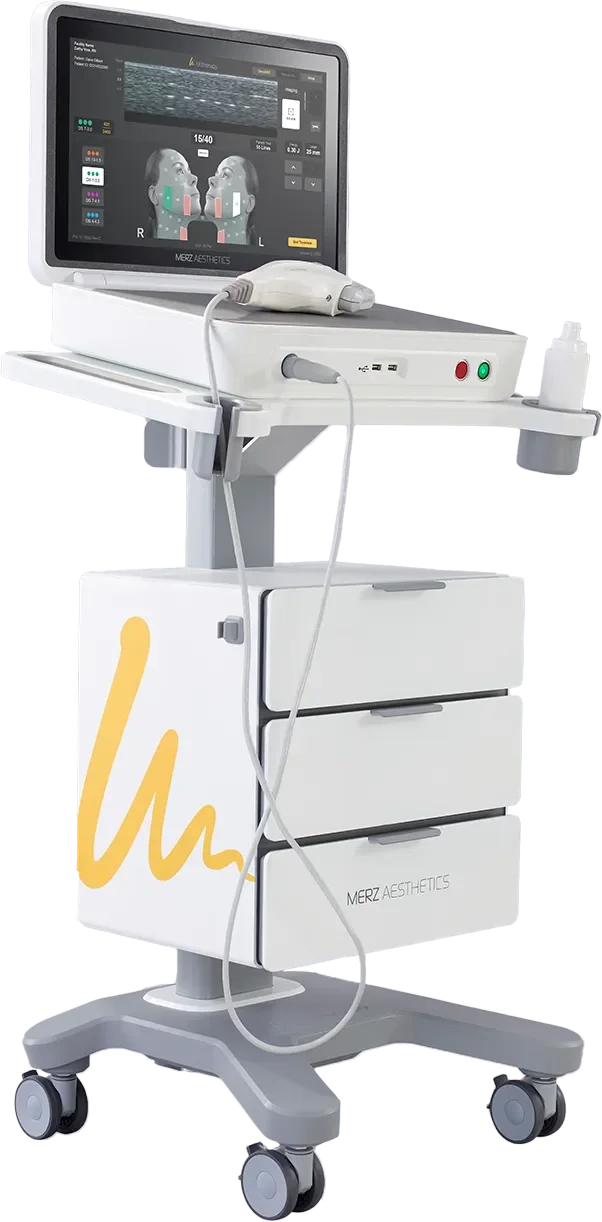
The Ulthera System delivers focused ultrasound below the skin surface to create controlled thermal coagulation points. The subsequent tissue response develops over time rather than producing an instant mechanical pull. The FDA summary says the device is intended for noninvasive aesthetic use, and that its DeepSEE function visualizes dermal and subdermal tissue layers to support coupling and appropriate treatment depth.
Visualization matters near the forehead because the operator must identify the tissue layer and avoid inappropriate structures. It does not automate diagnosis, choose the treatment lines or make the eye area risk-free. The physician still determines whether the brow region is appropriate, which transducer and depth fit the anatomy, and where treatment must stop.
The device name alone is therefore not a plan. Direction of treatment lines, energy delivery, the amount of tissue available and individual anatomy can change the response. A conservative map may be more appropriate than covering a larger area, especially when the brow is asymmetric or the visible concern has more than one cause.
What the clinical evidence can—and cannot—predict
Published studies support the possibility of measurable brow elevation, but they do not establish one universal result. A 2024 prospective study of focused ultrasound in the upper face reported a mean brow elevation of 2.16 millimeters at 90 days among 40 participants who completed follow-up. That study evaluated a focused-ultrasound protocol; its average cannot be transferred into an individual Ultherapy Prime promise.
An earlier prospective study of microfocused ultrasound with visualization in 25 Asian participants reported a mean brow lift of 0.47 millimeters at 90 days. At 180 days, the group mean was 0.12 millimeters below baseline and was not statistically significant. Different devices, protocols, measurements, faces and follow-up periods help explain why a single millimeter claim would be misleading.
Small studies can show that a change is possible, but they are not a guarantee of visibility, symmetry or duration. Photographic angle, facial expression and measurement method also matter. AP865 should document standardized photographs and the agreed review point so that a subtle change is not judged from unmatched selfies.
Who may discuss it—and when a different question comes first
Someone concerned about mild brow descent or upper-face laxity may discuss focused ultrasound after an in-person physician assessment. A useful consultation examines the brow at rest and in movement, compares both sides and considers the forehead, eyelid and orbital anatomy together. Age or a photograph alone cannot establish suitability.
Pause when the area has an active skin problem, an open lesion, unexplained swelling, altered sensation, an unresolved reaction or recent surgery that has not been medically reviewed. Disclose previous forehead or eye procedures, energy treatments, threads and injectables by exact product, date and location. The physician must also review the current device instructions and personal medical history before deciding whether to proceed.
Ultherapy may be the wrong category when the main issue is excess eyelid skin, structural eyelid position, marked hollowing, prominent fat, edema, pigment or another condition that ultrasound cannot diagnose or correct. A private consultation should make room for observation, staging, another treatment category or referral instead of treating simply because the device is available.
- Is the concern brow position, eyelid skin, volume, muscle activity or swelling?
- Where will every treatment line begin and stop relative to the orbital rim?
- Which transducer and visualized tissue layer are proposed, and why?
- What previous eye-area or forehead procedures need to be considered?
- Would observation or a staged plan make the response easier to interpret?
The eye-safety boundary is not negotiable
The Ultherapy Prime instructions warn that the system should not be used on the eyes, eyelids or within the orbital rim. They also state that energy should never be directed toward the eye. These are treatment boundaries, not optional preferences, and they should be explained before consent.
Real-time ultrasound visualization helps the trained operator confirm coupling and tissue depth, but it does not justify moving inside a prohibited area. A plan that promises direct eyelid tightening with Ultherapy conflicts with the current instructions reviewed for this guide. If the concern is primarily on the eyelid, the physician should discuss the diagnostic limits and appropriate alternatives rather than relabeling brow treatment as eyelid treatment.
Ask the clinic to identify the exact console, transducer and planned map. The record should state which areas were treated and which were deliberately avoided. That level of documentation supports continuity if the visitor later sees another clinician outside Korea.
Recovery, risks and reasons to seek prompt review
Clinical-trial effects listed in the current instructions include redness, swelling, pain, welting and bruising. Temporary numbness, tingling, tenderness or localized weakness can also occur. Burns or scarring are possible when technique is incorrect, and post-market reports include nerve effects and vision changes. Frequency and severity vary, so a short expected recovery should not be described as no risk.
Eye pain, vision change, marked light sensitivity, suspected burn, blister, severe or progressive swelling, new weakness or another rapidly worsening symptom needs prompt in-person medical assessment. Photographs and messaging are not substitutes for examining an unexpected eye-area or neurologic symptom.
For an overseas visitor, recovery planning includes a local review window, a written contact route and a plan for care after leaving Seoul. The travel schedule should not force a same-day decision or make immediate departure the default. Staging another treatment can also make it clearer which procedure caused a reaction.
How AP865 can make a subtle treatment decision more reliable
A private AP865 consultation should begin with the person's goal, examination, previous records and travel responsibilities—not a preset number of lines. The physician can explain whether a modest brow-position change is a realistic target, which findings will remain unchanged and why treating less may be the more coherent plan.
If treatment proceeds, keep the device model, transducer, visualized depth, treatment map, date, expected response, aftercare and contact route in the record. Standardized photographs should use the same head position, expression and lighting. Privacy should be agreed before any eye-area images are exchanged for follow-up.
Continuity matters because change is gradual and may be subtle. Agree on when an in-person or photographic review would be meaningful, which warning signs require earlier assessment and what information should travel with the visitor. That makes the brow plan part of longitudinal skin and aging care rather than an isolated machine appointment.
COMMON QUESTIONS
Before you book
Is Ultherapy FDA-cleared to lift the eyebrows?
Yes. The current US FDA clearance for the Ulthera System lists lifting the eyebrow, but describes a temporary aesthetic change rather than a surgical or assured result.
Does a brow indication mean Ultherapy can treat the upper eyelid?
No. Current instructions say not to use the system on the eyes, eyelids or within the orbital rim, and energy must never be directed toward the eye.
How many millimeters of brow lift should I expect?
No single number can be promised. Published averages vary across devices, protocols, participants and follow-up periods, and an individual change may be subtle or not visible.
When might a brow-position change appear?
Change is generally assessed over time as the tissue response develops, not immediately after treatment. The meaningful review point should be agreed with the physician because timing and visibility vary.
Is an Ultherapy brow treatment the same as eyelid surgery or botulinum toxin?
No. Focused ultrasound, surgery and neuromodulator injections act on different tissues and answer different findings. An examination should identify the cause of the concern before selecting or combining categories.
SOURCES & FURTHER READING
Check the original information
- AP865 — official current program overview
- US FDA — Ulthera System with UC-1 PRIME 510(k) summary K233996
- Ultherapy Prime — current instructions for use and safety boundaries
- US FDA — Ulthera System eyebrow and submental indication record K121700
- PubMed — 2024 prospective focused-ultrasound upper-face study
- PubMed — 2017 MFU-V brow-lift study in Asian participants
- PubMed — customized MFU-V face and neck pilot study
- PubMed — focused ultrasound technique and line orientation
Published October 29, 2026 · Last reviewed for factual accuracy October 29, 2026. Product availability, regulation and treatment protocols can change.