AT A GLANCE
- Technology
- Synchronized RF heating plus HIFEM muscle stimulation
- Typical official protocol
- Four 30-minute sessions, 5–10 days apart
- Evidence boundary
- Studies evaluate courses, not a guaranteed one-session outcome
- Recovery
- Often no scheduled downtime; temporary muscle fatigue or tenderness may occur
- Reviewed
- 3 November 2026
The short answer: one visit is possible, but it is not the studied course
A single EMSCULPT NEO appointment can fit into a Seoul visit when the treatment area and medical screening are appropriate. It may also help a visitor learn how the contractions and heat feel. What it cannot do is reproduce, on evidence alone, the outcomes reported after a planned series of treatments.
The current manufacturer protocol typically includes four 30-minute sessions spaced 5 to 10 days apart. A sham-controlled abdominal trial used three weekly sessions, while a recent multicenter flank study used four sessions. Those protocols do not prove that everyone needs the same number, but they do mean that a one-session promise would go beyond the evidence being cited.
AP865's current official program lists EMSCULPT NEO. That confirms the consultation scope, not personal suitability or a predetermined series. A private appointment should first identify the body area, the change the visitor is seeking, relevant health history, travel dates and whether reliable follow-up is possible after returning home.
What the device combines—and what that does not tell you
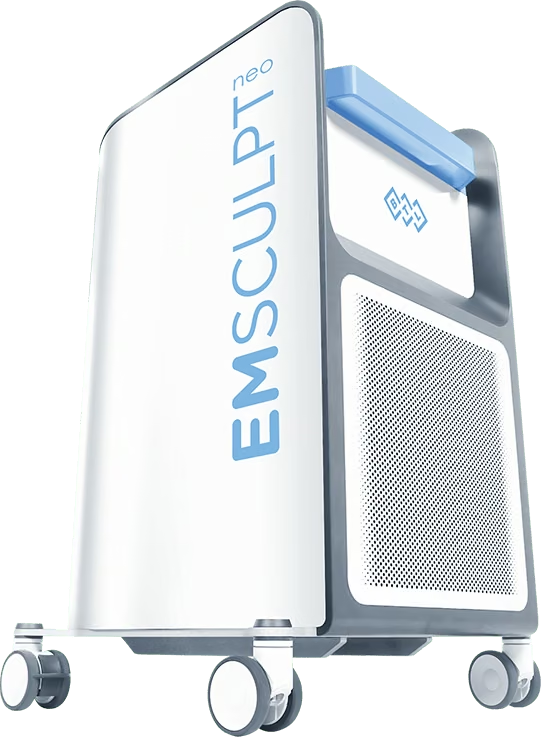
EMSCULPT NEO combines high-intensity focused electromagnetic stimulation, often abbreviated HIFEM, with synchronized radiofrequency heating. The electromagnetic component produces repeated muscle contractions, while the radiofrequency component heats tissue during the same appointment. The manufacturer describes different applicators for large, curved and smaller body areas.
A device name does not select the correct area, intensity or plan. Abdomen, flanks, buttocks, thighs, arms and calves differ in anatomy, applicator fit and published evidence. The physician must decide whether the proposed target is primarily muscle conditioning, contour, another tissue concern or something that this technology is not designed to answer.
Regulatory language is also narrower than advertising shorthand. The current manufacturer information lists specific muscle-conditioning and noninvasive lipolysis indications by body area and skin type. It does not support describing the treatment as weight loss, a substitute for exercise, a cure for a medical condition or a guaranteed visible transformation.
What published treatment courses actually studied
A 2023 systematic review identified 15 clinical studies of HIFEM body contouring, including two studies of EMSCULPT NEO. The typical protocol across the literature was four treatments over two to four weeks, with a broader range of three to eight sessions. The authors also noted variation in treated areas, imaging methods and follow-up, which limits simple comparisons.
The first sham-controlled randomized trial of synchronized radiofrequency and HIFEM enrolled 72 participants and used three 30-minute abdominal treatments, one week apart. A 2024 multicenter MRI study of the flanks scheduled four bilateral 30-minute treatments at approximately weekly intervals. Both evaluated change after the final treatment rather than treating the first session as the endpoint.
These studies make a course-based response plausible, but they do not predict what one visitor will see or feel. Some studies were small, several involved manufacturer relationships, and protocols differ by area. Standardized photographs, the same posture and a pre-agreed review point are more informative than an immediate mirror check after one appointment.
What one Seoul appointment can responsibly accomplish
One appointment can provide an in-person examination, screening, applicator-fit assessment and—if appropriate—a first treatment. It can also reveal whether the heat and strong contractions are tolerable. That is useful information, but tolerance during one session is not evidence that more treatment is automatically needed or that a particular visible result will follow.
For a short-stay visitor, three coherent options should remain open. The physician may recommend one treatment with no claim of a course result, advise completing a properly spaced course with one accountable provider, or decline treatment when screening, timing or continuity is weak. Splitting a series between clinics can make settings, records, response and responsibility harder to interpret.
If a course is discussed, the plan should explain why each session is proposed, the interval, which area and applicator are intended, how response will be documented and who will review an unexpected symptom after departure. A preset bundle is not a substitute for those decisions.
- Which body area and tissue goal are being assessed?
- What published protocol is most relevant to that area?
- Why is one appointment, a series or no treatment the preferred option?
- Who keeps the device, applicator, settings and response record?
- How will review and urgent contact work after the visitor leaves Seoul?
Screening matters because strong stimulation and heat are not neutral
A noninvasive appointment still requires medical screening. Disclose implanted electronic or metal devices, previous surgery, altered sensation, injury, unresolved pain, skin problems in the treatment area and any health condition that may affect tolerance of heat or strong muscle stimulation. The physician should use current device instructions and the examined anatomy rather than a generic online checklist.
Treatment should pause when the history is incomplete, the proposed area cannot be assessed confidently or follow-up would be unreliable. A body-contouring goal should not be used to diagnose or manage unexplained weakness, pain, swelling or another medical symptom. Those concerns need the appropriate medical evaluation first.
Published trials reported close monitoring and selected participants. That controlled setting is different from assuming that a short visit makes everyone a candidate. AP865's concierge position is strongest when the consultation can narrow, stage or decline a plan without pressure to fill the itinerary.
Recovery is often compatible with ordinary plans, but sensation varies
The manufacturer describes no scheduled downtime, and many people can return to ordinary activity after treatment. During the appointment, intense contractions and warmth are expected. Temporary muscle fatigue, tenderness or a post-workout feeling may occur, and individual experience varies with the area and settings.
A 'no downtime' label does not mean no observation or no risk. Stop and seek prompt assessment for pain that is severe or increasing, a suspected burn or blister, marked swelling, new weakness, persistent altered sensation or another symptom that is unusual or worsening. Remote messaging can support communication but cannot replace an examination when a significant symptom develops.
Avoid stacking several body or energy procedures simply because the calendar is short. Staging makes recovery easier to interpret and preserves a clearer record of what caused a response. Travel, exercise and other treatment plans should be discussed for the individual rather than inferred from a general marketing phrase.
How AP865 can turn one visit into a continuity plan
A private AP865 consultation should begin with the visitor's own goal, body-area examination, previous procedures and travel responsibilities. The physician can explain what EMSCULPT NEO may address, what it will not address and why the published evidence does or does not fit the proposed plan.
If treatment proceeds, the record should identify the exact device, applicator, body area, date, settings, expected sensations, aftercare and contact route. Any progress photographs should use consistent posture, distance and lighting, with explicit agreement about privacy, storage and sharing.
The meaningful endpoint is not how many appointments can be fitted into Seoul. It is whether the decision, sequence, spacing and review remain medically coherent after the visitor leaves. That continuity is what distinguishes concierge care from an isolated machine session.
COMMON QUESTIONS
Before you book
Can I have just one EMSCULPT NEO session in Seoul?
Possibly, after an in-person medical screening. One appointment may be a first treatment, but it should not be presented as equivalent to the three- or four-session courses evaluated in published studies.
How many EMSCULPT NEO sessions are usually planned?
The current manufacturer protocol typically describes four 30-minute sessions spaced 5 to 10 days apart. Published studies have used different protocols, so the examined area, health history and continuity plan should guide the decision.
Does EMSCULPT NEO replace exercise or produce weight loss?
No. It should not be described as a substitute for exercise or as a weight-loss treatment. Its regulatory and evidence boundaries concern specific muscle-conditioning and body-contouring uses.
Is there downtime after EMSCULPT NEO?
The manufacturer describes no scheduled downtime, but intense contractions and heat are expected during treatment, and temporary muscle fatigue or tenderness may occur. Unusual or worsening symptoms need prompt assessment.
Should I complete a course at different clinics while traveling?
That may weaken continuity because applicators, settings, records and follow-up responsibility can become fragmented. If a course is appropriate, discuss whether one accountable provider can plan, document and review it coherently.
SOURCES & FURTHER READING
Check the original information
- AP865 — official current program overview
- BTL — official EMSCULPT NEO technology, protocol and indications
- PubMed — systematic review of HIFEM with and without radiofrequency
- PubMed Central — sham-controlled randomized abdominal trial
- PubMed — multicenter MRI study of lateral-abdomen treatment
- US FDA — powered muscle stimulator product classification
Published November 3, 2026 · Last reviewed for factual accuracy November 3, 2026. Product availability, regulation and treatment protocols can change.