AT A GLANCE
- Shared material family
- Both current Korean product listings identify PDLLA with hyaluronic acid
- Standard Juvelook
- 50 mg total: 42.5 mg PDLLA and 7.5 mg HA on the current manufacturer page
- Volume family
- Current listings include 100 mg and 200 mg presentations; exact availability and selection require confirmation
- Reviewed
- 25 October 2026
The short answer: they share ingredients, not one treatment role
Juvelook and Juvelook Volume both combine poly-D,L-lactic acid, or PDLLA, with hyaluronic acid. The current Korean manufacturer page lists different total amounts for the standard and Volume presentations. That difference does not make Volume a universally stronger or better Juvelook, and it does not choose a treatment area by itself.
The physician first needs to separate fine surface change from a deeper fold, contour deficit, scar, pigment, swelling or laxity. Those findings can look similar in photographs but lead to different conversations. A product name cannot make that diagnosis or establish that an injection is appropriate.
At AP865, the useful comparison is therefore product-specific and anatomy-led: what is being treated, which exact sealed product is proposed, why its presentation fits the plan, what evidence applies, how recovery may affect the visit and how follow-up will continue after the traveler leaves Seoul.
What the current Korean product information establishes
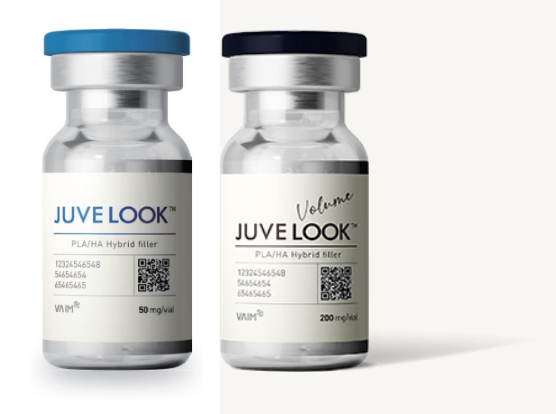
VAIM's current Korean product page identifies Juvelook as a class 4 medical device and lists PDLLA plus HA as the principal materials. Standard Juvelook is listed at 50 mg total, comprising 42.5 mg PDLLA and 7.5 mg HA. Juvelook Volume is listed at 200 mg total, comprising 170 mg PDLLA and 30 mg HA.
The same page now also lists Juvelook Volume 100 at 100 mg total, comprising 85 mg PDLLA and 15 mg HA. AP865's current program page confirms Juvelook and Juvelook Volume, but it does not establish that every presentation is stocked on every date. The exact vial and current availability should be confirmed before a plan is made.
The manufacturer states the same broad Korean intended purpose for these listed products: temporary improvement of adult facial wrinkles through physical restoration after subcutaneous injection of polylactide and HA. That shared wording does not make the formulations, preparation, placement or treatment goals interchangeable.
Why a larger product amount is not a result score
The number printed for the product amount describes the contents of a vial, not the amount that should be placed in one area, the number of sessions a person needs or the size of a result. Preparation, final suspension, placement depth, technique and anatomy still shape the procedure.
Manufacturer material describes the Volume family for more focused contour and deeper-line conversations, while standard Juvelook is commonly discussed for finer skin-quality concerns. Those descriptions are a starting point, not a substitute for examination or permission to use either product in every marketed area.
Ask the physician to show the sealed vial and name the exact variant. The record should distinguish standard Juvelook, Volume 100 and Volume 200 rather than shortening all three to 'Juvelook.' It should also document the treated area, preparation and amount actually used.
What the evidence can say—and where it stops
A multicenter randomized trial of 260 participants compared an injectable PDLLA product with an HA filler for nasolabial folds and followed participants for 52 weeks. It supports a role for PDLLA in a defined fold study, but it does not compare standard Juvelook directly with Juvelook Volume or establish one plan for every facial area.
A 2026 prospective case series studied Juvelook in 20 participants with nasolabial folds over three sessions and reported improvement at three months after the final session. The small sample, repeated treatment course and short product-specific follow-up limit how far the result can be generalized, especially to Volume products or other anatomy.
A 2026 rabbit-ear study deliberately injected Juvelook and Juvelook Volume into arteries to examine short-term vascular behavior. It was a preclinical model with seven-day tissue follow-up, not evidence that accidental vascular injection is safe in a human face. Its most useful message for a visitor is that product, preparation and injection volume can change behavior and that human anatomical judgment remains essential.
Who may discuss either product—and who should pause
An adult asking about selected wrinkles, skin texture, a fold or a contour concern may reasonably discuss the product family after an in-person examination. The consultation still needs to decide whether the finding is actually suited to an injectable and whether a non-injectable option, staged care, observation or no treatment during this trip makes more sense.
Pause an automatic same-day injection when there is active inflammation or infection, an unexplained lump, incomplete records of previous filler or biostimulator treatment, a recent procedure in the same area, an important event with no recovery margin or no realistic route to medical review after departure.
Medicines and supplements, allergy and healing history, dental or facial infection, previous delayed swelling, current symptoms and all earlier injectables belong in the physician's screening conversation. An online photograph can organize the history, but it cannot choose the product or placement plan.
Recovery and serious injection risks belong in the comparison
Redness, swelling, tenderness, bruising, itching or palpable irregularity can occur after facial injections. Their visibility and duration can vary with product, preparation, area, placement, technique and individual response. Neither product has a universal photo-ready or flight-ready interval.
FDA guidance for dermal fillers describes uncommon but serious risks including infection, nodules or granulomas, allergic reaction, tissue injury and accidental injection into a blood vessel, which can cause skin necrosis, vision abnormalities, blindness or stroke. This guidance is not a US approval statement for Juvelook products; it provides an important safety boundary for any facial injection discussion.
Unusual or worsening pain, white, gray or blue skin, visual disturbance, weakness, speech difficulty, rapidly increasing swelling, spreading redness, drainage, fever, breathing difficulty or another rapidly worsening response needs prompt in-person assessment. A travel schedule should never be used to dismiss a warning sign.
Do not turn the comparison into a same-day combination
Sharing a material family does not create a reason to use standard Juvelook and Volume together. If different concerns are present, the physician should explain whether they can be observed, prioritized or treated in stages and how one intervention may affect interpretation of the next.
The same restraint applies to energy devices, other fillers, toxin and skin-care procedures. Sequence and spacing depend on the areas, tissue planes, expected inflammation, evidence, previous procedures and the ability to review the response—not on fitting the longest menu into a short Seoul visit.
A private concierge plan may intentionally do less: one clearly documented intervention, time to observe, and a later decision using the response. Continuity is more valuable than an overloaded first appointment whose effects cannot be separated.
What a private AP865 consultation should record
Bring the concern, previous injectable names and dates, treated areas, photographs or records, medicines and supplements, allergies, healing history, event date and departure time. Ask the physician to state the exact product and presentation rather than recording only the Juvelook brand family.
A useful record includes the sealed product name, lot and expiry, preparation, amount used, treated areas, placement approach, expected reactions, warning signs and follow-up contact. Another licensed clinician should be able to understand what was done if review is needed after the visitor leaves Seoul.
AP865 can then design the visit around privacy, sufficient consultation, recovery and long-term continuity. The final answer may be standard Juvelook, a Volume presentation, another approach, staged care or no injection that day. Preserving that choice is part of physician-led high-end care.
- What finding are we treating, and why is an injectable appropriate?
- Which exact Juvelook presentation is proposed, and why does it fit this area?
- What product amount, preparation and placement approach will be recorded?
- What visible recovery and uncommon risks apply to this plan?
- How can I obtain in-person review after leaving Seoul?
COMMON QUESTIONS
Before you book
What is the main difference between Juvelook and Juvelook Volume?
Both current Korean listings identify PDLLA plus HA, but the products have different presentations and total amounts. Standard Juvelook is listed at 50 mg, while the Volume family includes 100 mg and 200 mg presentations. Those numbers do not choose the treatment area or predict a result.
Is Juvelook Volume simply a stronger Juvelook?
No. A larger product amount is not a treatment-quality score. The physician must match the exact product, concern, anatomy, preparation and placement plan and explain why that presentation is appropriate.
Do Juvelook and Juvelook Volume have different Korean intended purposes?
The current manufacturer page states the same broad intended purpose for the listed products: temporary improvement of adult facial wrinkles through physical restoration after subcutaneous injection of polylactide and HA. Their product presentation and clinical planning still differ.
Can Juvelook and Juvelook Volume be used in one appointment?
Do not assume they should be combined. Different findings may be prioritized or staged, and the physician should explain the evidence, areas, tissue planes, recovery burden and how each response will be reviewed.
What should an international visitor confirm before treatment?
Confirm the exact sealed product and presentation, lot and expiry, Korean labeled purpose, proposed area, preparation, amount used, placement approach, expected recovery, warning signs, written record and a route to in-person follow-up after departure.
SOURCES & FURTHER READING
Check the original information
- AP865 — official current program overview
- VAIM — official Korean Juvelook product information
- VAIM — official Juvelook Volume 100 product-line announcement
- PubMed — randomized multicenter PDLLA versus HA nasolabial-fold study
- PubMed — prospective Juvelook nasolabial-fold case series
- PubMed — preclinical Juvelook and Juvelook Volume vascular-behavior study
- US FDA — dermal filler risks and patient safety guidance
Published October 25, 2026 · Last reviewed for factual accuracy October 25, 2026. Product availability, regulation and treatment protocols can change.