
AT A GLANCE
- Eye Tip
- 0.25 cm²; the manufacturer describes precise, shallow heating for the periorbital area or eyelid
- Eye protection
- Upper or lower eyelid and within-orbital-rim treatment requires plastic eye shields—not metal shields
- Evidence boundary
- Published periorbital studies include earlier Thermage generations or other monopolar RF devices, not a guarantee for one FLX plan
- Reviewed
- 18 October 2026
The short answer: the eye plan is not a smaller face plan
Eye Thermage uses the same broad category of monopolar radiofrequency as facial Thermage, but the treatment area changes the hardware and safety steps. Solta Medical describes a 0.25 cm² Eye Tip for precise, shallow heating around the eye or on the eyelid itself. Its larger 3.0 and 4.0 cm² Total Tips are presented for facial lines and wrinkles rather than as substitutes over the eye.
For treatment of the upper or lower eyelids, or within the orbital rim, the manufacturer requires plastic eye shields and specifically says not to use metal shields. It also says vibration should not be used around the eyes while those shields are in place because displacement can increase the risk of corneal abrasion or ocular damage.
That means the useful first question is not how many pulses fit into an eye package. It is whether the visible concern is appropriate for Thermage FLX Eye, which exact areas may be treated, and whether the physician can complete the eye-specific protection and follow-up plan safely.
What the 0.25 cm² Eye Tip changes
The manufacturer describes the Eye Tip as providing precise, shallow heating for periorbital wrinkles and the eyelid. The stated tip area is 0.25 cm², compared with 3.0 or 4.0 cm² Total Tips listed for broader facial treatment. Tip size is therefore a treatment-design detail, not a score that can be compared by pulse count alone.
The current US indications include non-invasive treatment of periorbital wrinkles and rhytids, including the upper and lower eyelids. An indication describes the device's authorized use; it does not prove that every eye-area concern comes from the same tissue or will respond in the same way.
AP865's current official program lists Thermage FLX Eye separately from Thermage FLX. The clinic's official site also announces a November grand opening and says reservations are being accepted, so international visitors should confirm the operating date, device availability and consultation schedule for their own visit.
Start with the eye concern—not the device name
Fine lines, eyelid skin laxity, brow position, under-eye volume, puffiness, muscle movement and a true eyelid disorder can look similar in a photograph but are not interchangeable concerns. Thermage FLX does not replace an appropriate eye examination or establish the cause of a change from a selfie.
A consultation may be reasonable when the concern is mild-to-moderate periorbital wrinkling or skin laxity and the physician considers monopolar RF appropriate after examining the area. Another evaluation may be more important when the main issue involves vision, new asymmetry, a changing lesion, marked lid droop, significant swelling, pain or another symptom rather than a stable cosmetic concern.
The physician may recommend treating a limited zone, using another approach, waiting, referring for another assessment or doing no procedure. A concierge plan should protect that choice instead of treating the eye area as an automatic add-on to a full-face session.
Eye shields are part of the procedure—not an optional comfort step
Solta Medical's current safety information requires plastic eye shields for upper or lower eyelid treatment and for treatment within the orbital rim. It says metal shields must not be used because radiofrequency current and metal protection are not an interchangeable safety combination.
The same information says vibration should not be used around the eye while plastic shields are in place, because shield movement can increase the risk of corneal abrasion or ocular damage. Ask who will place and remove the shields, how the eyes will be checked, and what sensation should be reported immediately during treatment.
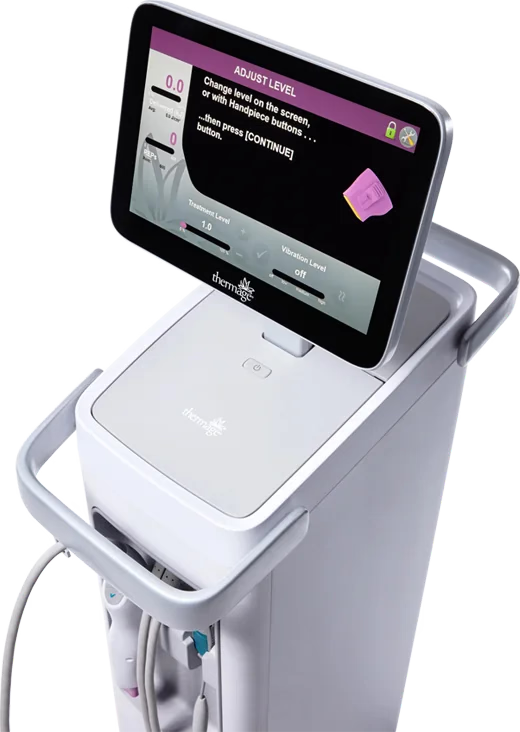
A photo of the device does not verify operator training, the tip, the shield or the treatment map. Those details belong in the in-person consent discussion, especially when an international visitor may have limited time for local review after the appointment.
What the clinical evidence can—and cannot—support
A 2003 multicenter study followed 86 people after one periorbital treatment with the earlier ThermaCool TC system for six months. Blinded photographs showed at least a one-grade wrinkle improvement in 83.2% of evaluated periorbital areas, while treating physicians recorded improvement in 28.9% of areas without referring to baseline photographs and half of participants reported being satisfied or very satisfied. Different assessment methods produced different-looking results.
That study also reported a 0.36% incidence of second-degree burns per RF application and small residual scars in three participants at six months. The device generation, protocols and reporting are not the same as a current personalized Thermage FLX Eye plan, so the paper supports neither a guaranteed outcome nor a claim of zero risk.
A 2018 Korean study of 70 women reported a 15.19% mean reduction in measured periorbital wrinkle area after three monopolar RF sessions two weeks apart, with transient mild redness as the reported adverse effect. It used another monopolar RF protocol, not Thermage FLX Eye. Category-level evidence can inform the conversation, but it should not be presented as product-specific proof.
Recovery is often limited, but the risk list is not empty
The manufacturer lists mild-to-moderate pain during treatment and reports after-treatment reactions that can include swelling, redness or blanching, hives, bruising, altered sensation, pigment change, surface irregularities, lumps or nodules. Blisters, burns, scabbing and scarring are also included among reported reactions.
Around the eyes, temporary swelling can be more noticeable than the same degree of swelling elsewhere on the face. Recovery also matters practically: a visitor may need time without a photo event, a long travel day or another eye-area procedure, even when ordinary activity is possible.
Eye pain, visual change, severe or worsening swelling, blistering, a burn or another unexpected symptom should not be managed from a generic aftercare article. Contact the treating clinic promptly and obtain urgent in-person assessment when the symptom could involve the eye or vision.
Who should pause before assuming it is suitable
Thermage FLX is contraindicated for people with an implantable pacemaker, automatic implantable cardioverter-defibrillator or another implantable electrical device. The manufacturer also says the system has not been studied over skin fillers or in several groups and conditions listed in its precautions, including pregnancy or breastfeeding, diabetes, autoimmune disease, cold sores, herpes simplex, epilepsy, permanent makeup and tattoos.
Those statements are not a complete medical screening checklist and they do not decide individual care. Tell the physician about eye surgery, eye disease, dry-eye symptoms, contact lenses, previous injectables or energy treatments, permanent makeup, implanted devices, current medicines and any prior unexpected reaction.
When records are incomplete or the examination raises uncertainty, waiting is a valid high-end decision. A shorter itinerary or a pre-booked treatment slot should not overrule an unresolved safety question.
How AP865 can plan eye-area care with continuity
AP865 can begin with the change the visitor notices, the expression and eye shape they want to preserve, previous treatment records and the travel calendar. The physician can then separate eyelid skin, brow position, volume, movement and symptoms before deciding whether Thermage FLX Eye belongs in the plan.
For an international visitor, the plan should name the device and tip, the exact zones, the reason for eye protection, expected reactions, warning signs and the follow-up route after leaving Seoul. If another facial device or injectable is being considered, the sequence should be explained rather than bundled by default.
Privacy and continuity are part of the clinical experience: enough consultation time, a private setting for examination, a clear written record and a realistic way to review recovery. The most considered treatment may be a carefully limited eye plan—or a decision to wait.
Questions to settle before an Eye Thermage appointment
Ask whether the physician considers the concern to be periorbital wrinkling or laxity that Thermage FLX Eye is intended to address, and what competing explanations need to be excluded. Confirm which parts of the upper lid, lower lid or orbital rim are being considered and which areas will not be treated.
Ask to confirm the 0.25 cm² Eye Tip, the use of plastic eye shields and how shield placement and removal are managed. Ask which reactions are expected, which symptoms require immediate assessment and how long the physician wants you to remain available for local follow-up.
Finally, disclose previous eye procedures, injectables, energy treatments and implanted devices, and ask how another planned treatment would change the sequence. A trustworthy plan should remain understandable even if you decide to postpone it.
COMMON QUESTIONS
Before you book
How is Eye Thermage different from face Thermage?
The manufacturer lists a 0.25 cm² Eye Tip for precise, shallow heating around the eyes or on the eyelid. The larger 3.0 and 4.0 cm² Total Tips are listed for broader facial treatment, and eyelid treatment adds eye-specific protection and handling requirements.
Are eye shields required for Eye Thermage?
Yes for treatment of the upper or lower eyelids or within the orbital rim. Solta Medical requires plastic eye shields, says not to use metal shields and warns against using vibration around the eyes while the shields are in place.
Can Eye Thermage treat every under-eye concern?
No. Periorbital wrinkles or skin laxity, volume change, puffiness, muscle movement and eye or eyelid disorders are different concerns. An in-person assessment should establish what is being addressed and whether another evaluation or no procedure is more appropriate.
What recovery can occur after Eye Thermage?
Reported reactions for Thermage treatment include pain during treatment and temporary swelling, redness, blanching, bruising or altered sensation afterward. Burns, blistering, scabbing, scarring, pigment change, surface irregularities, lumps or nodules have also been reported, so individual recovery and warning signs should be discussed before treatment.
What should an international visitor confirm before treatment?
Confirm the exact device and Eye Tip, treatment zones, plastic eye-shield plan, relevant medical and eye history, previous procedures, expected recovery, warning signs, written treatment record and a realistic follow-up route after leaving Seoul.
SOURCES & FURTHER READING
Check the original information
- AP865 — official current program overview
- AP865 — official opening and reservation status
- Solta Medical — Thermage FLX system, Eye Tip, indications and safety information
- US FDA — Thermage FLX System 510(k) K170758
- PubMed — multicenter study of periorbital radiofrequency with an earlier Thermage system
- PubMed Central — monopolar RF study for periorbital wrinkles in Korean patients
Published October 18, 2026 · Last reviewed for factual accuracy October 18, 2026. Product availability, regulation and treatment protocols can change.